
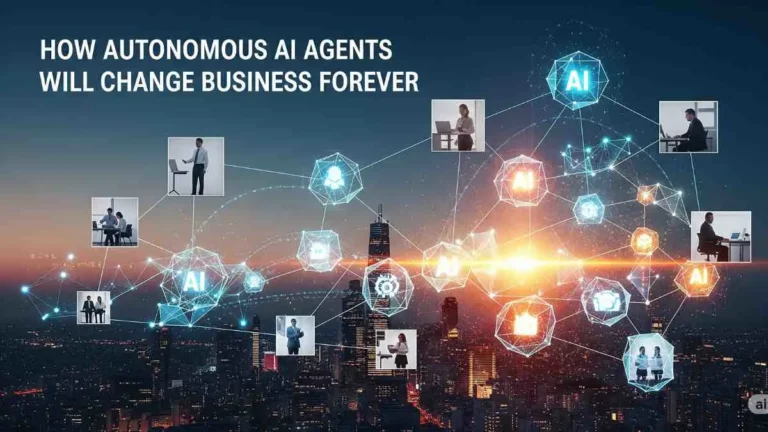
Imagine stepping into your office one day and realizing daily tasks—emails, inventory, finances, marketing, support—are already completed before you even log in. The staff isn’t burning the midnight oil; autonomous AI agents have taken over the routine workload.
While chatbots represented the first wave of conversational AI, autonomous agents mark the transition from answering questions to taking actions. By equipping language models with tools, persistent memory, and continuous execution loops, organizations can deploy digital teammates capable of executing end-to-end business workflows.
How Autonomous Agents Differ from Simple AI Assistants
Standard AI systems wait passively for a prompt, generate text, and stop. Autonomous agents operate on an iterative loop: Perceive → Plan → Act → Reflect.
- Tool Invocation: Agents can browse the live web, execute code in sandboxed environments, interact with APIs, and read internal corporate spreadsheets.
- Self-Correction: When an API returns an error or a calculation doesn't reconcile, the agent analyzes the failure and tries an alternate approach.
- Multi-Agent Collaboration: Specialized agents can divide tasks—for example, one researcher agent gathers market intelligence, an analyst agent evaluates pricing, and a copywriter agent drafts client briefs.
Key Enterprise Use Cases in 2025
Businesses adopting agentic workflows are recording extraordinary efficiency improvements across core verticals:
- Supply Chain & Inventory Management: Agents track stock fluctuations, automatically negotiate replenishment orders with vendor APIs, and reroute shipments around weather disruptions.
- Sales Outreach & Lead Qualification: Autonomous outbound agents research potential prospects, tailor personalized demonstration pitches, and coordinate calendar bookings.
- Financial Auditing & Bookkeeping: Continuous reconciliation of receipts, payroll discrepancies, and regulatory filings without human bottlenecks.
The Competitive Imperative
For modern business leaders, the question is no longer whether to adopt AI agents, but how quickly they can integrate them into existing operational pipelines to gain durable market advantages.